
A commercial wheelchair lift is a vertical or inclined platform lift designed to provide safe and convenient access for wheelchair users and people with limited mobility. It is commonly installed in commercial buildings, public facilities, schools, hospitals, offices, hotels, churches, retail stores, and other locations where stairs or changes in floor level create an accessibility barrier.
For buildings where a conventional passenger elevator or a long access ramp is impractical, a wheelchair platform lift can provide a more compact and cost-effective accessibility solution.
TUHE provides customized commercial wheelchair lifts for indoor and outdoor applications, with different platform sizes, lifting heights, cabin configurations, power supplies, and safety options available according to project requirements.
What Is a Commercial Wheelchair Lift?
A commercial wheelchair lift, also called a wheelchair platform lift or vertical platform lift, carries a wheelchair and its occupant between different levels.
Unlike a stairlift, the user does not need to transfer from the wheelchair to a seat. The wheelchair is driven directly onto the lifting platform, secured in position, and raised or lowered to the required landing.
Commercial wheelchair lifts can be designed for:
Single-level access
Raised entrances
Mezzanines
Balconies
Basement access
Split-level commercial buildings
Indoor and outdoor applications
Existing buildings and accessibility retrofit projects
The appropriate lift configuration depends on the lifting height, available installation space, platform size, number of stops, building structure, and local accessibility and safety requirements.

Wheelchair lifts, also known as wheelchair lift platforms, can be installed in family or business stairs, and are often added to private and public vehicles to meet the requirements of the disability act for barrier free facilities. These mobile devices are usually installed in homes as alternatives to stair lifts that transport only passengers, not his / her wheelchair or scooter.
Why Use a Wheelchair Lift in a Commercial Building?
Accessibility is an important consideration when designing or renovating a commercial property. A wheelchair lift can help overcome changes in floor level without requiring a large ramp structure.
A commercial wheelchair lift can be particularly useful when:
Limited Space Is Available
A ramp can require a significant amount of horizontal space, especially where the vertical height is substantial. A vertical platform lift can use a much smaller footprint.
An Existing Building Needs Accessibility Upgrades
Retrofitting an existing building may make it difficult to install a conventional elevator. A wheelchair platform lift can provide an alternative where the building layout and applicable regulations permit its use.
A Short Vertical Travel Is Required
Wheelchair lifts are well suited to relatively short vertical travel between entrances, floors, platforms, and other elevated areas.
Indoor and Outdoor Access Is Required
Depending on the configuration and enclosure, commercial wheelchair lifts can be installed inside a building or outside the building envelope.
Indoor and outdoor commercial wheelchair lifts
The operation mode of indoor commercial wheelchair lift is very similar to that installed in the shaft or in the shaft. Although the installation of vertical platform elevator is similar to elevator, the price is much cheaper. Some models of wheelchair hydraulic lifts provide some options to complete the vertical platform lift, making it more like a home lift. Especially in hospitals, schools, supermarkets and other places, this kind of commercial wheelchair elevator has been widely used.
Outdoor wheelchair lifts include factory built enclosures that protect users from the weather and keep them dry. The Enclosure acts as an access door inside the device, and the door is added to the entrance or exit. The manufacturing process of commercial outdoor wheelchair lift is complex, and the details can be customized according to the site environment. Let the function of commercial outdoor wheelchair lift play a real role.

Types of Commercial wheelchair lift
Commercial stair wheelchair lift
The commercial stair wheelchair lift is to lift people, usually with disabilities, up and down the stairs by mechanical devices. For stairs of sufficient width, guide rails shall be installed on the treads of stairs. The chair or lifting platform is fixed on the guide rail. A person sitting on a chair or platform and being lifted up or down stairs by a chair moving along the tracks. The lift of stair lift should not be confused with the lift used by skiers. The term "stair climber" can refer to both stair lifts and, more generally, commercial stair track lifts.
Although different countries and regions in the world have different travel well-being for the disabled or the elderly, the operators of commercial buildings need to be recognized by people from all walks of life and should consider the convenience of their visits. The design of commercial wheelchair lifts in suitable building areas can bring systematic benefits.
Although the installation of commercial wheelchair lift will bring cost pressure, there must be someone to help you spread the convenience of your commercial building and attract more people to your consumption. It can play an advantage of avoiding peer competition.
Commercial vehicle wheelchair lift
Car wheelchair lift, because with a very delicate shape and powerful function, for your barrier free travel escort, so also has its commercial function. For many car rental companies, the installation of such commercial vehicle mounted wheel lifts greatly expands the car rental business.
Generally, the commercial vehicle wheelchair lift is installed under the vehicle chassis, which does not affect the door trafficability, does not occupy the vehicle interior space, so that the field of vision is more spacious, and the vehicle interior space can be fully utilized.
The commercial vehicle wheelchair lift is suitable for the middle door, which is installed under the vehicle chassis with a thickness of 90mm, so that your car can adapt to more road conditions. When in use, you only need to touch the button to operate, the platform will sound an alarm during the movement, with the function of interlocking with the vehicle; With internal safety locking mechanism; Automatic inner and outer baffles; All electro hydraulic system ensures smooth movement.
It is mainly used for cars, SUV and MPV models. The original seat can be used to refit the wheelchair lift system. The rotation path can be programmed through the hand-held switch. It can be controlled through the hand-held switch, remote control switch and seat switch. The car wheelchair lift makes the travel of the elderly, the disabled, the escort and other people with mobility difficulties more free, fast and comfortable!
We can see that because of the wide application of commercial wheelchair lifts in various scenarios, commercial wheelchair lifts have a broader market base. To develop the deep user needs of customers, commercial wheelchair lifts not only bring convenience to the elderly and people with disabilities, but also bring rich returns to operators.
Commercial barrier free elevator
It is a lift specially designed and manufactured for the disabled. For the convenience of the disabled travel and sightseeing, in the community, hospitals, schools, hotels, public places and other places. Next to the escalator of the tourist ladder passage, the barrier free elevator is installed. The barrier free lift can accommodate wheelchair access. The disabled or the disabled just need to press the help button at both ends, and the person on duty will immediately start the automatic lift.
The installation of commercial wheelchair lift has been included in the legal provisions
Many legal systems in various countries / regions stipulate the use of wheelchair lifts, set standards for wheelchair lifts, and require some types of enterprises to drive vehicles with the commercial wheelchair lifts into parking lots. In some cases, accessibility standards have been implemented in legal solutions. If the commercial wheelchair lift is damaged or fails, it should be repaired immediately; Establish the system of regular and frequent maintenance and inspection for wheelchair lift; Remove the vehicle and provide service if the lift is not available (except in exceptional circumstances); Alternative transportation is provided when the lift is not working and more than 30 minutes from the next accessible bus.
Although some trucks accessible by wheelchair lifts use electric lifts to assist passengers boarding, full-size vans need platform lifts. Two types of platform lifts are installed on wheelchair accessible trucks: one arm and two arms. Single arm wheelchair lifts are only used for side entry applications. They occupy less internal space and keep the passenger entrance open; However, their lifting capacity is lower than that of double arm lift. Most dual arm wheelchair lifts can lift up to 800 pounds. These lifts take up more interior space and block side entry and, for these reasons, are usually installed at the rear of the vehicle for rear entry applications.

Where Are Commercial Wheelchair Lifts Used?
Commercial wheelchair lifts can be customized for a wide range of applications.
Schools and Universities
Wheelchair lifts can provide access to raised entrances, classrooms, stages, libraries, and other areas with changes in floor level.
Hospitals and Healthcare Facilities
Accessibility is especially important in healthcare environments. Platform lifts can be used to connect different levels where a suitable accessible route is required.
Hotels
Hotels may use wheelchair lifts to improve access to entrances, public areas, restaurants, meeting rooms, and other facilities.
Offices and Commercial Buildings
A wheelchair lift can help provide access between split levels, raised entrances, mezzanines, and other areas where conventional elevator installation may not be practical.
Retail Stores
Stores with steps at entrances or different floor levels can consider platform lifts as part of an accessibility solution, subject to applicable building requirements.
Churches and Places of Worship
Wheelchair lifts can provide access to raised platforms, entrances, and other areas used by visitors.
Public Buildings
Libraries, community centers, government buildings, and other public facilities may require accessible routes for people with mobility limitations.
Vertical Wheelchair Lift vs. Stairlift
Commercial wheelchair lifts and stairlifts are not the same type of equipment.
A stairlift normally carries a person on a seat along a staircase. A wheelchair platform lift carries the wheelchair itself.
For users who need to remain in their wheelchair during transportation, a platform lift can provide direct wheelchair access without requiring a transfer.
The choice depends on the building layout, available space, user requirements, lifting height, and applicable regulations.
Vertical Platform Lift or Commercial Elevator?
A conventional passenger elevator is designed for transportation between floors and is typically the standard solution for accessible routes between stories where required.
A platform lift may be considered where applicable regulations permit it, particularly for certain existing-building conditions, limited vertical travel, or locations where an elevator or ramp is technically impractical.
The U.S. Access Board explains that platform lifts may be used in specific situations defined by the ADA Standards, including certain existing-building conditions and areas such as performance platforms, incidental spaces, and locations where existing exterior site constraints make a ramp or elevator infeasible.
Therefore, a commercial wheelchair lift should not automatically be treated as a substitute for a passenger elevator in every commercial building. The project should be reviewed according to the applicable building, accessibility, electrical, and safety codes.
Indoor Commercial Wheelchair Lift
An indoor wheelchair lift is designed for installation inside commercial buildings.
Typical applications include:
Indoor entrances
Split-level floors
Mezzanines
Raised platforms
Stages
Schools
Offices
Hospitals
Hotels
Retail buildings
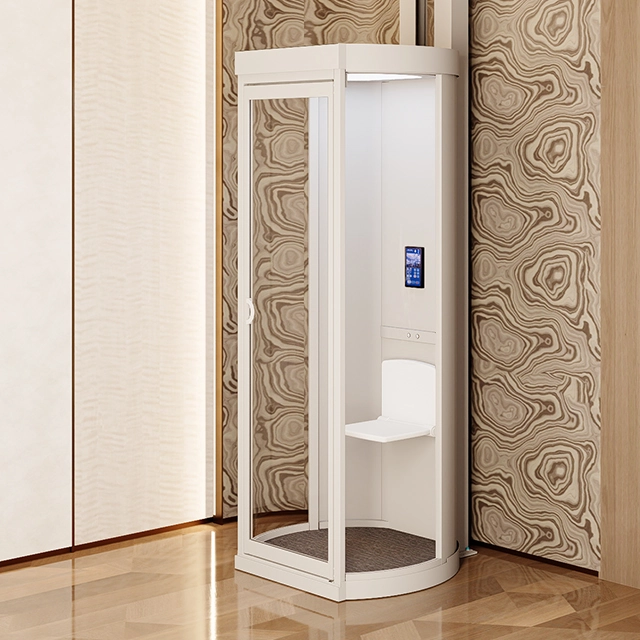
For indoor installations, customers can select different platform dimensions, cabin designs, door configurations, and finishes according to the available space and architectural requirements.
TUHE commercial wheelchair lift models can be customized with platform dimensions and different cabin configurations. Some models use hydraulic drive systems and can be configured with partial or full-height enclosures.
Outdoor Commercial Wheelchair Lift
An outdoor wheelchair lift needs to be designed for changing weather conditions and the specific installation environment.
Depending on the project, an outdoor lift may include:
Weather-resistant materials
Protective enclosure
Safety gates
Anti-slip platform
Emergency stop
Manual emergency lowering
Safety sensors
Automatic or fixed access ramps
Outdoor platform lifts are commonly considered for entrances, raised sidewalks, terraces, balconies, and other exterior level changes.
TUHE also offers customized exterior wheelchair platform lift configurations for commercial applications, including different cabin and door arrangements.
Key Features of a Commercial Wheelchair Lift
A commercial wheelchair lift should be designed around accessibility, safety, durability, and ease of operation.
Common features include:
Anti-Slip Platform
The platform surface should provide suitable traction to help keep the wheelchair stable during lifting and lowering.
Safety Interlock
Safety interlocks can prevent operation when the required door or gate is not properly secured.
Emergency Stop
An emergency stop button allows the lift to be stopped quickly when necessary.
Obstacle Detection
A safety sensor can detect an obstruction beneath or around the platform and stop movement.
Emergency Lowering
A manual emergency lowering system can provide a way to lower the platform safely in the event of a power failure, depending on the lift design.
Automatic Ramps or Access Ramps
Ramps help wheelchair users enter and exit the platform smoothly.
Constant-Pressure Controls
Constant-pressure controls can require the user to continuously operate the control during movement, depending on the system configuration and applicable requirements.
TUHE models can be configured with features such as anti-skid platforms, bottom obstacle sensors, emergency stop buttons, safety interlocks, and manual emergency lowering systems.
Commercial Wheelchair Lift Specifications
The correct specifications depend on the project rather than one standard configuration.
Typical specifications to consider include:
| Specification | Typical Configuration |
|---|---|
| Lift Type | Vertical Platform Lift |
| Load Capacity | Up to approximately 350–400 kg on selected TUHE models |
| Platform Size | 1000 × 1400 mm or customized |
| Lifting Height | Customized according to project |
| Power Supply | 110V / 220V / 380V or customized |
| Drive System | Hydraulic or other configuration depending on model |
| Installation | Indoor or outdoor |
| Cabin | Open, half-enclosed, or full-height enclosure |
| Door Configuration | Front, rear, side, or customized |
| Control | Platform controls / remote or external controls depending on model |
For example, TUHE's commercial wheelchair lift range includes models with approximately 400 kg load capacity and customized platform dimensions, while some configurations are available for lifting heights of several meters. Exact specifications should be confirmed according to the selected model and project requirements.
How Much Does a Commercial Wheelchair Lift Cost?
The commercial wheelchair lift cost can not be a unified answer. Because there are different scenes, there will be different wheelchair lift structure, size, material, technical content, commercial wheelchair lift cost will be different.
The final price can be affected by:
Lifting height
Platform dimensions
Load capacity
Indoor or outdoor installation
Cabin and enclosure design
Number of stops
Door configuration
Hydraulic or other drive system
Safety equipment
Customization
Installation conditions
Shipping and local installation costs
Applicable local code requirements
For this reason, there is no single price that applies to every commercial wheelchair lift.
A more accurate quotation should be based on the actual project dimensions and requirements.
The installation cost of wheelchair lift also has to be considered. It is suggested to choose a professional team for full communication, so as to obtain the most accurate answer of commercial wheelchair lift cost.
In some countries, because of the actions of the government, some legal provisions have been passed for the physically handicapped, so that they can feel the convenience of going out and the welfare brought by the progress of society.
Commercial Wheelchair Lift and ADA Requirements
For projects in the United States, accessibility requirements should be reviewed before selecting and installing a wheelchair lift.
The ADA Standards address platform lifts under Section 410. Among other requirements, platform lifts used as part of an accessible route must provide unassisted entry and exit, and platform surfaces, clear floor space, controls, doors, and gates must meet the applicable requirements.
For example, the ADA Standards specify a maximum 1¼-inch clearance between the platform sill and the landing edge, while end doors or gates generally require a minimum 32-inch clear width and side doors or gates a minimum 42-inch clear width.
However, ADA compliance is not determined only by the lift itself. The complete installation, building layout, accessible route, local building codes, electrical requirements, and other applicable standards should also be considered.
Before ordering a commercial wheelchair lift for a U.S. project, it is important to confirm the requirements with the relevant architect, contractor, authority having jurisdiction, or accessibility professional.
What Should You Consider Before Buying a Commercial Wheelchair Lift?
Before requesting a quotation, prepare the following information:
1. Lifting Height
Measure the vertical distance between the lower and upper landing.
2. Platform Size
Consider the wheelchair dimensions, turning requirements, and whether an attendant needs to travel with the user.
3. Available Installation Space
Provide the available width, depth, and overhead clearance around the proposed lift location.
4. Indoor or Outdoor Installation
Outdoor applications may require additional protection against weather and environmental conditions.
5. Number of Stops
Identify how many levels the lift needs to serve.
6. Door Direction
Determine whether users will enter and exit from the same side, opposite sides, or adjacent sides.
7. Required Load Capacity
The lift should be selected based on the combined requirements of the wheelchair, user, and any permitted attendant or additional load.
8. Local Regulations
Confirm applicable accessibility, building, electrical, fire, and safety requirements before installation.
9. Power Supply
Provide the available voltage and phase information so the manufacturer can select a compatible system.
10. Customization Requirements
Commercial projects may require customized platform sizes, finishes, enclosures, doors, controls, or installation arrangements.
Why Choose a Customized Commercial Wheelchair Lift?
Every commercial building has different structural and accessibility requirements.
A customized wheelchair lift can be adapted to:
Different lifting heights
Different platform sizes
Limited installation spaces
Indoor or outdoor environments
Different landing configurations
Front or side access
Partial or full enclosure
Different power supplies
Specific architectural requirements
TUHE offers OEM and customized commercial wheelchair lift solutions and lists configurations with customized platform dimensions, power supplies, lifting heights, cabin designs, and other options.
Commercial Wheelchair Lift Manufacturer
Choosing the right manufacturer is important because a commercial wheelchair lift is not simply a standard lifting machine. The manufacturer should be able to understand the installation environment and provide a suitable configuration.
When comparing manufacturers, consider:
Product specifications
Load capacity
Maximum lifting height
Safety configuration
Customization capability
Manufacturing experience
Installation support
Spare parts availability
After-sales service
Applicable certifications and documentation
Export experience
TUHE is a wheelchair lift manufacturer based in China offering OEM and customized wheelchair lift solutions for commercial and residential applications. Its product range includes vertical platform lifts for indoor and outdoor applications.
Get a Commercial Wheelchair Lift Quote
If you are planning a commercial accessibility project, provide the following information to the manufacturer:
Required lifting height
Platform size
Load capacity
Number of stops
Indoor or outdoor installation
Available installation space
Door opening direction
Local power supply
Preferred cabin design
Project location
With these details, the manufacturer can recommend a suitable commercial wheelchair lift configuration and provide a more accurate quotation.
Looking for a customized commercial wheelchair platform lift? Contact TUHE with your project requirements to discuss platform size, lifting height, load capacity, cabin design, power supply, and other customization options.


222.webp)
660.webp)
503.webp)