Investing in a car lift is one of the most transformative decisions you can make for your home garage or professional shop. It unlocks a new level of capability, safety, and convenience for vehicle maintenance and storage. However, the market is dominated by two primary designs: the 2-post lift and the 4-post lift. Choosing between them isn't just about preference; it's about aligning the tool with your specific goals. This comprehensive guide dives deep into every critical aspect of this decision, backed by technical data, safety standards, and practical insights to ensure you make the perfect choice.
The Foundational Difference: How They Work
At their core, these lifts operate on fundamentally different principles, which dictates their entire range of applications.
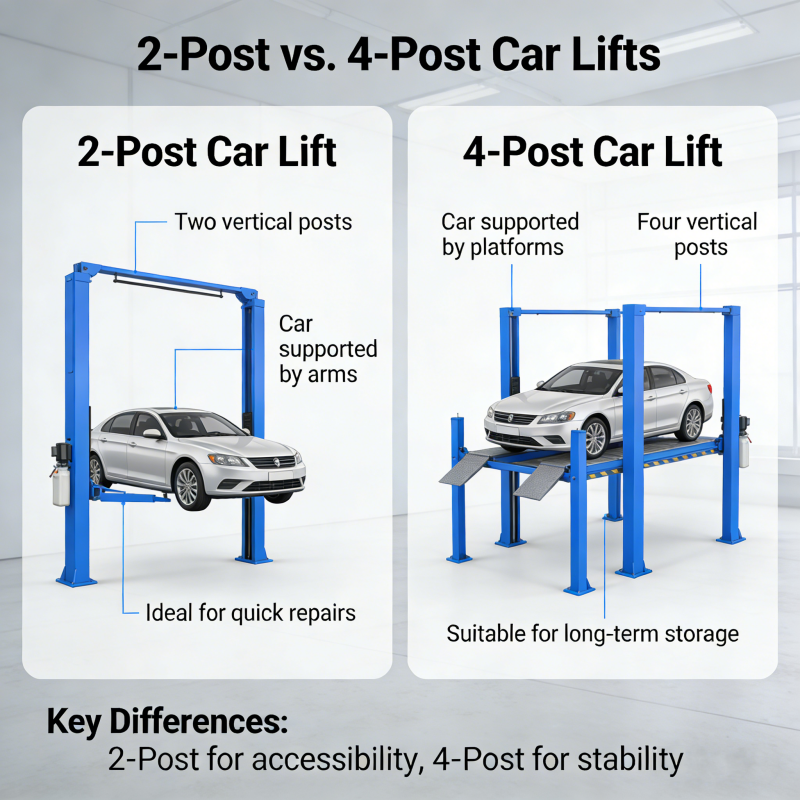
The 2-Post Lift: This is the quintessential service lift. It features two vertical columns anchored firmly to your garage floor. From these posts, adjustable arms extend inward to cradle your vehicle at its designated structural lifting points—typically reinforced frame rails or chassis pinch welds. Once lifted, the car is suspended in mid-air, leaving the entire area beneath it completely open and unobstructed. This design is purpose-built for mechanics who need to work on the vehicle's undercarriage.
View Related Products: 3.5T 4T 4.5T Two Post Car Lift
3.5T 4T 4.5T 5T Clear Floor Hydraulic Two Post Car Lift
The 4-Post Lift: This is primarily a storage and parking lift, though it has service applications. It consists of four vertical posts connected by two long, parallel runways. You simply drive your vehicle onto these runways, and the entire platform, with the car resting on its tires, is raised vertically. The vehicle remains on a solid, stable surface, much like it’s still on the ground, but at an elevated height.
This core distinction—lifting the chassis versus lifting the tires—creates a cascade of differences in use, safety, installation, and cost.
Learn more about the different types of car lifts: Types of hydraulic car lift for garage
In-Depth Feature & Specification Comparison
To move beyond generalities, let's examine the key specifications and features side-by-side. The data below reflects industry standards for quality, certified lifts in the consumer and light-commercial market as of 2026.
| Feature | 2-Post Car Lift | 4-Post Car Lift |
|---|---|---|
| Primary Function | Vehicle Service & Repair (e.g., oil changes, brake jobs, exhaust work, transmission service). | Vehicle Storage & Parking (e.g., storing a classic car, freeing up floor space, parking a second vehicle). Also suitable for basic maintenance. |
| Under-Vehicle Access | Unmatched. Provides 360-degree, completely open access to the entire underside. Essential for complex repairs. | Limited. The runways block direct access to the center of the vehicle (engine, transmission, fuel tank). Access is only possible from the sides. |
| Lifting Method | Lifts from the vehicle's structural chassis/frame. Requires user knowledge of safe lifting points for each specific vehicle. | Lifts from the vehicle's tires. No need to locate chassis points; simply drive on. Much more intuitive for beginners. |
| Stability | Very stable when properly installed and loaded correctly. The vehicle is suspended, so it can sway slightly if bumped. | Extremely stable. The vehicle sits on a solid, level platform, creating a "ground-like" feel. Ideal for long-term parking and for users who prioritize a secure, immobile platform. |
| Weight Capacity | Common capacities range from 9,000 lbs to 15,000 lbs, sufficient for most passenger cars, SUVs, and light trucks. Heavy-duty commercial models go much higher. | Common capacities are similar, typically 10,000 lbs to 18,000 lbs. Some models designed purely for storage may have lower capacities. |
| Floor Requirements | Critical. Requires a minimum of 4-6 inches of reinforced concrete with a compressive strength of at least 3,000 PSI. Must be anchored with high-grade concrete anchors. Installation is complex and often requires professional help. | More Flexible. Can often be installed on a standard 4-inch, 3,000 PSI concrete slab. Many models are "free-standing" and don't require permanent anchoring (though it's highly recommended for safety). Assembly is generally simpler. |
| Overhead Clearance | Maximum. Since there’s no platform under the car, you get the full height of your garage ceiling minus the height of the lift’s crossbar. Ideal for taller vehicles. | Slightly Reduced. You lose the height of the runway structure (typically 6-8 inches) from your total available clearance. |
| Safety Certification | Must be certified to ANSI/ALI ALCTV. Look for the official gold certification label from the Automotive Lift Institute (ALI). This is non-negotiable. | Must also be certified to ANSI/ALI ALCTV. The same gold certification label is an absolute requirement for any reputable lift. |
| Typical Price Range (2026) | $2,500 - $6,000+ for a quality, certified model suitable for a home or small shop. | $2,800 - $7,000+ for a quality, certified model. Basic storage models can start lower, while heavy-duty or feature-rich models cost more. |
Read this article to understand how car lifts work: How Does a Hydraulic Car Lift Work
The Non-Negotiable: Safety Standards Explained
Your safety is paramount. The automotive lift industry in North America is governed by a single, rigorous safety standard: ANSI/ALI ALCTV. This standard, developed jointly by the American National Standards Institute (ANSI) and the Automotive Lift Institute (ALI), covers every aspect of a lift’s design, construction, testing, and required safety mechanisms.
What does this mean for you?
It means that any lift you purchase must have been independently tested by a third-party Nationally Recognized Testing Laboratory (NRTL) to prove it meets these stringent requirements. The proof is the gold-colored certification label affixed to the lift by the ALI.
Never, under any circumstances, buy a lift without this label. An uncertified lift is a gamble with your life. The standard ensures the lift has proper safety locks, overload protection, and structural integrity to handle its rated capacity safely.
When a 2-Post Lift is the Clear Winner
If your primary goal is to perform serious mechanical work on your vehicle, a 2-post lift is the only logical choice. Its open-center design is its superpower.
Professional-Grade Repairs: Tasks like replacing an oil pan gasket, dropping a transmission, welding on an exhaust system, or performing a full brake job become dramatically easier and safer. You can roll a creeper anywhere under the car and use a full set of jack stands on the solid floor for an extra layer of safety during major component removal.
Wheel Alignment: Professional alignment racks are specialized 2-post lifts equipped with turnplates and slip plates in the lift arms. This allows the wheels to turn and slide freely while the vehicle is in the air, which is essential for accurate alignment readings.
Maximizing Garage Utility: A 2-post lift effectively doubles your garage’s usable space. You can park a daily driver or store tools and equipment underneath the lifted project car.
Important Consideration: Using a 2-post lift correctly requires education. You must consult your vehicle’s owner’s manual or a reliable service guide to find the manufacturer-approved lifting points. Placing the arms incorrectly can cause severe damage to your car’s unibody or frame.
When a 4-Post Lift is the Ideal Solution
If your main objectives revolve around storage, convenience, or simple tasks, the 4-post lift offers unmatched benefits.
Long-Term Vehicle Storage: This is the classic application. For classic car collectors or owners of seasonal vehicles, a 4-post lift is perfect. The car rests on its tires, which is generally better for tire health than sitting on jack stands for months on end. The stable platform prevents suspension components from being held in a constant state of extension. Many models even come with optional casters, allowing you to roll the entire lifted vehicle around your garage for cleaning or to access other items.
Ease of Use and Beginner-Friendliness: There’s a very low learning curve. You simply drive on, engage the locks, and you’re done. There’s no risk of misplacing lift arms. This makes it an excellent choice for DIYers who want to perform basic tasks like changing all four tires, rotating tires, or inspecting the undercarriage without the complexity of a 2-post.
Safe Parking Platform: In a multi-car household, a 4-post lift can serve as a secure, elevated parking spot for a second vehicle, freeing up valuable floor space for projects or other uses.
The trade-off is clear: you sacrifice the ability to perform any repair that requires central undercarriage access.
Long-Term Ownership Costs & Maintenance Requirements
The initial purchase price is just the beginning. Understanding the long-term maintenance needs of your lift is crucial for ensuring its longevity and safety.
Both 2-post and 4-post lifts share common hydraulic systems, and their maintenance schedules are largely similar:
Hydraulic Oil: This is the lifeblood of your lift. Most manufacturers recommend changing the hydraulic fluid every 1-2 years or after approximately 500 lift cycles, whichever comes first. Over time, the oil can break down, absorb moisture, and accumulate debris, leading to sluggish operation or potential system failure. Always use the type of hydraulic oil specified in your lift’s manual (typically AW32 or AW46).
Cable Inspection (for cable-driven models): Many 2-post and some 4-post lifts use steel cables to synchronize the lift arms or runways. These cables should be inspected monthly for signs of fraying, kinking, or corrosion. A simple test is to run a rag along the length of the cable; if the rag snags, it’s a sign of broken strands.
Lubrication: Key pivot points, such as the joints on the lift arms and the slider blocks, require regular lubrication with a high-quality, lithium-based grease. This should be done every 6 months to prevent premature wear and ensure smooth operation.
Safety Lock Testing: Your lift’s safety locks are its final line of defense. Test them every month by raising the lift a few inches and engaging the locks. Then, gently lower the lift onto the locks to ensure they catch and hold the weight securely.
A well-maintained lift can last for decades, making this small investment of time and money well worth it.
Installation Complexity & Associated Costs Explained
Installation is a critical and often underestimated part of the buying process. The costs and complexity differ significantly between the two types.
2-Post Lift Installation:
Concrete Requirements: This is non-negotiable. A 2-post lift exerts tremendous force on its anchor points. Your garage floor must be a minimum of 4-6 inches thick and have a compressive strength of at least 3,000 PSI. If your existing slab doesn’t meet these specs, you’ll need to pour a new one, which can cost anywhere from $500 to $2,000+ depending on your location and the size of the pad.
Professional Installation: Due to the critical nature of the anchoring and the weight involved, professional installation is highly recommended and often costs 10-20% of the lift’s purchase price. This ensures the lift is perfectly level and securely fastened, which is vital for safety.
4-Post Lift Installation:
Concrete Requirements: While a solid foundation is always best, many 4-post lifts are designed as “free-standing” units. They distribute their load over a wider area and can often be installed on a standard 4-inch, 3,000 PSI residential slab without requiring new concrete work.
DIY-Friendly: 4-post lifts are generally much more DIY-friendly. They are assembled from pre-fabricated parts with bolts and typically do not require permanent anchoring to the floor (though it’s still a good safety practice). This can save you the cost of professional installation.
Before purchasing, always measure your garage’s ceiling height, door width, and available floor space to ensure a proper fit.
Real User Voices: A Summary of Community Forum Experiences
Online communities like Reddit’s r/MechanicAdvice and r/CarLifts are treasure troves of real-world experience. Here’s a synthesis of common user sentiments:
2-Post Users: “It’s a game-changer for working on cars. Once you get used to finding the right lift points, you’ll never go back.” “The open bay is incredible, but I was terrified the first time I lifted my car. Do your research!” “Worth every penny if you’re serious about wrenching.”
4-Post Users: “Perfect for storing my summer car. I just drive it on in November and off in April.” “So easy to use. My wife can put the car on it without any help.” “I bought it thinking I could do repairs, but quickly realized I couldn’t get to the middle of the car. Great for storage, not for service.”
A common regret among buyers is choosing a 4-post lift for its ease of use, only to discover they can’t perform the repairs they wanted. Conversely, some 2-post owners wish they had a 4-post for simple storage. Be brutally honest with yourself about your primary use case.
Considerations for Specific Vehicle Types
Your choice of lift can also be influenced by the types of vehicles you own:
Low-Ground Clearance Vehicles (e.g., Sports Cars, EVs like Tesla): Both lift types can work, but require attention to detail. For a 2-post lift, you’ll likely need frame contact pads or lifting pucks that fit into the vehicle’s factory jack points to avoid damaging the underbody. For a 4-post lift, ensure the distance between the runways is narrow enough for the vehicle’s wheelbase and that the entry ramps are low-profile enough for the car to drive on without scraping.
Large SUVs and Trucks: Both types are available in heavy-duty configurations. A 4-post lift can be a stable and convenient way to park a large truck, while a 2-post lift provides the necessary access for servicing its complex drivetrain and suspension.
Classic and Collector Cars: For long-term storage, a 4-post lift is often preferred. Keeping the car on its tires is gentler on the suspension and tires than having it sit on jack stands for extended periods. The stable platform also minimizes any stress on the chassis.
Making Your Final, Confident Decision
To cut through the noise, ask yourself this single, decisive question:
"What will I be doing with my vehicle 80% of the time when it's on the lift?"
If your answer is "Working on it," then the 2-post lift is your indispensable partner. Its superior access will save you countless hours of frustration and enable you to tackle complex jobs with confidence.
If your answer is "Storing it" or "Performing simple tasks like tire changes," then the 4-post lift is your best friend. Its stability, ease of use, and storage capabilities will perfectly match your needs.
By understanding these fundamental differences, respecting the critical safety standards, and honestly assessing your own garage goals, you can invest in a car lift that will provide years of reliable, safe, and productive service.
Essential Safety Accessories You Shouldn’t Skip
While an ALI-certified lift is the foundation of a safe garage, several key accessories act as your final, critical line of defense. These are not optional extras—they are essential investments in your personal safety.
Vehicle Support Stands (Jack Stands): This is the single most important accessory. Never work under a vehicle supported only by the lift’s hydraulic system or its mechanical locks. Hydraulic systems can develop leaks, and while rare, mechanical components can fail. Always lower the vehicle onto a set of high-quality, appropriately rated (e.g., 6,000-lb capacity) steel jack stands placed on solid concrete under the vehicle’s frame rails or other designated support points. This provides a completely independent, passive safety barrier between you and disaster.
Lift Pad Adapters & Rubber Contact Pads: Your lift arms come with standard rubber pads, but they may not be ideal for every vehicle. For cars with sensitive unibody construction or specific factory jack points (common on European and modern vehicles), investing in a set of frame contact pads or lifting pucks is crucial. These adapters fit perfectly into your car’s designated jacking points, distributing the load evenly and preventing costly damage to your chassis or body panels.
Overhead Safety Bar (for 2-Post Lifts): Many 2-post lifts feature an overhead crossbar that can interfere with tall vehicles like SUVs or vans. A simple yet effective solution is an overhead safety bar. This is a horizontal bar that attaches to the top of the posts, providing a physical stop to prevent the vehicle from being raised too high and potentially hitting your garage door opener or ceiling structure.
Myth-Busting: Common Misconceptions About Car Lifts
The world of car lifts is rife with myths that can lead to poor decisions or unnecessary fear. Let’s set the record straight.
Myth 1: “A 4-post lift is inherently safer than a 2-post lift.”
Reality: Both types are equally safe when they are ALI-certified and used correctly according to their design purpose. A 2-post lift is engineered to safely suspend a vehicle from its strong structural points, while a 4-post lift is designed to stably support it from its tires. The risk comes from misuse, not the design itself.
Myth 2: “If my garage floor is ‘good enough’ for parking, it’s good enough for a 2-post lift.”
Reality: This is dangerously false. A 2-post lift exerts immense, concentrated force on its anchor points. A standard residential slab (often only 3-4 inches thick) is almost certainly insufficient. Installing a 2-post lift on inadequate concrete can lead to the anchors pulling out, causing catastrophic failure. Always verify your floor meets the manufacturer’s specifications (typically 4-6 inches of 3,000+ PSI reinforced concrete).
Myth 3: “Once I buy a certified lift, I never have to worry about maintenance.”
Reality: Certification ensures the lift was built to a high standard, but it doesn’t make it maintenance-free. Like any complex mechanical system, regular checks and servicing (oil changes, cable inspections, lubrication) are required to maintain its integrity and safety over its long lifespan.
The Environmental Factor: How Your Garage Conditions Affect Your Lift
Your garage isn't just a container for your lift; its environment plays a direct role in the lift's performance and longevity.
Temperature Extremes: Hydraulic fluid viscosity changes with temperature. In very cold garages (below freezing), the oil can thicken, causing the lift to operate slowly or jerkily. In extremely hot environments, the oil can thin out excessively. While modern hydraulic oils are formulated to handle a wide range, consistently operating outside their optimal range can accelerate wear. If your garage is unheated in a harsh winter climate, be prepared for slightly slower operation until the system warms up.
Humidity and Corrosion: A damp or humid garage environment is the enemy of any metal machinery. Moisture can lead to corrosion on critical components like cables, anchor bolts, and the lift’s structural steel. To combat this, ensure your garage is well-ventilated. After use, wipe down any visible moisture from the lift’s surfaces. Regular lubrication of pivot points and cables also creates a protective barrier against rust.
Dust and Debris: A cluttered or dusty garage can introduce contaminants into the lift’s hydraulic system or cause debris to get caught in moving parts like the locking mechanisms. Keeping your garage clean and organized isn’t just about aesthetics—it’s a key part of your lift’s preventative maintenance routine. A clean environment helps ensure smooth, reliable, and safe operation for years to come.
About Tuhe Lift – Your Trusted Partner in Lifting Solutions
Founded in 2012 by six senior engineers in Jiyang—widely recognized as the “Hometown of China’s Lifting Platform Manufacturing”—Tuhe Lift is on a mission to become China’s leading lift manufacturer with world-class standards. With three modern production workshops, a dedicated exhibition hall, and a team of over 300 skilled employees, we serve clients both domestically and internationally through a network of 20 distributors.
Tuhe Lift independently develops six major product series encompassing more than 50 models, including scissor lifts, mast lifts, articulated boom lifts, cargo lifts, and home lift solutions. Our products are renowned for their high cost-performance ratio and reliable quality, backed by CE, SGS, and other international certifications.
We proudly export to markets across the USA, Australia, Germany, Algeria, Peru, and beyond. Offering OEM services and fully customized lifting solutions, we guarantee a 1-day design response, 7×24 online support, 7-day delivery, and a comprehensive 1-year warranty—all part of our one-stop service commitment to save you time and hassle.
With our own factories and showroom, we warmly welcome visits and seek long-term partnerships built on superior products, competitive pricing, and mutual trust. Choose Tuhe Lift—where innovation meets reliability.
222.webp)
660.webp)
503.webp)
695.webp)