Towable boom lifts have become an increasingly popular solution for working at height across construction, maintenance, landscaping, and utility industries. Their portability, cost efficiency, and ease of transport make them attractive alternatives to truck-mounted or self-propelled boom lifts. However, many contractors, rental companies, and end users continue to ask a critical question: are towable boom lifts safe?
This article provides a comprehensive, data-backed analysis of towable boom lift safety. By examining accident statistics, engineering design features, regulatory standards, and real-world use cases, we aim to give a clear, practical answer. We also explore how choosing a reliable manufacturer plays a decisive role in ensuring safety and productivity.
Understanding Towable Boom Lifts
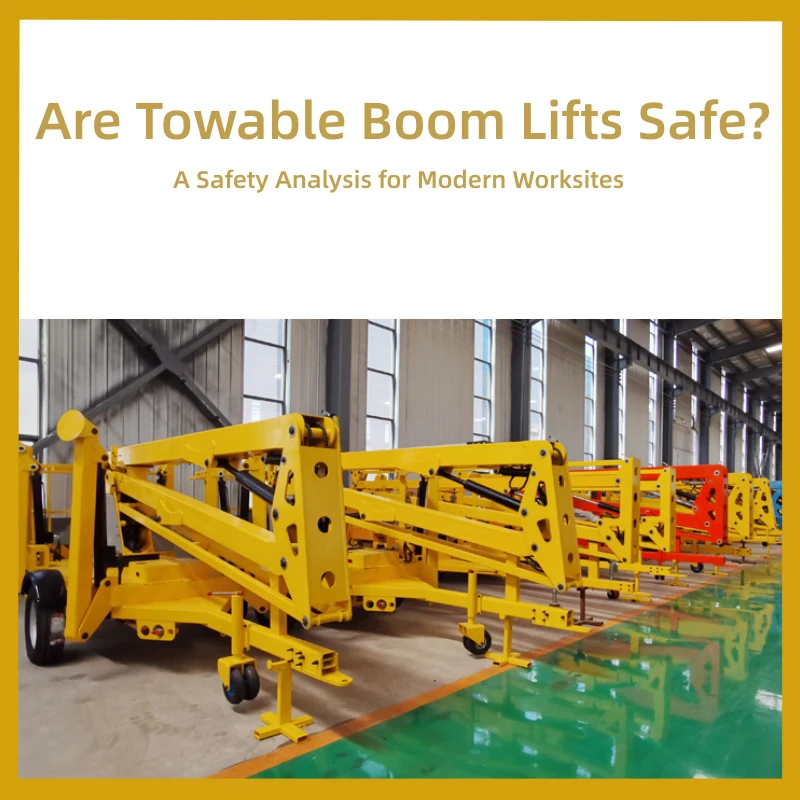
Towable boom lifts, also known as trailer-mounted boom lifts, are aerial work platforms designed to be towed by vehicles such as pickup trucks or vans. Unlike self-propelled lifts, they rely on external transportation but offer excellent reach and flexibility.
Read this article to learn which types of jobs a 50ft Towable boom lift is suitable for. What Kind of Work Is the Towable 50 ft Boom Lift Suitable For?
Key Characteristics:
Mounted on a trailer chassis
Outriggers for stabilization
Articulated or telescopic boom options
Powered by electric, gasoline, or hybrid systems
Typical working height: 10–30 meters
Their lightweight design and lower acquisition cost make them especially popular among small to medium-sized contractors.
View related products:
8m-22m Towable Diesel AC Battery Telescopic Factory Boom Lift Arm Aerial Work Platform
50ft OEM towable boom lift hydraulic aerial work platform factory price
OEM Towable Telescopic Articulating Electric Hydraulic Boom Lift manufacturer
Are Towable Boom Lifts Safe? A Direct Answer
Yes, towable boom lifts are safe when properly designed, maintained, and operated according to standards.
However, safety is conditional and depends on four main factors:
Equipment design and quality
Operator training and behavior
Jobsite conditions
Compliance with safety regulations
To better understand these conditions, we must examine safety data and accident causes.
Industry Safety Data: What the Numbers Say
1. Aerial Lift Accident Overview
According to data compiled from OSHA reports and international construction safety studies, aerial lift accidents remain a concern but are often linked to misuse rather than equipment failure.
Common Causes of Aerial Lift Accidents (%)
| Cause of Accident | Percentage |
|---|---|
| Operator error | 41% |
| Tip-over due to ground issues | 23% |
| Falls from platform | 19% |
| Mechanical failure | 9% |
| Electrical hazards | 8% |
Key insight: Only 9% of incidents are related to mechanical failure, highlighting the importance of operator training and ground assessment.
2. Towable Boom Lifts vs Other Lift Types
Accident Rates by Lift Type (per 100,000 operating hours)
| Lift Type | Accident Rate |
|---|---|
| Scissor lifts | 4.8 |
| Self-propelled boom lifts | 5.2 |
| Towable boom lifts | 4.1 |
| Truck-mounted lifts | 6.0 |
Towable boom lifts show a lower-than-average accident rate, largely due to:
Lower travel speed
Fixed working position
Outrigger stabilization systems
Engineering Features That Enhance Towable Boom Lift Safety
Modern towable boom lifts are engineered with multiple layers of safety protection.
1. Structural Stability
Outriggers distribute weight evenly across the ground, reducing the risk of tip-over. Many models include automatic leveling systems that prevent operation unless the lift is fully stabilized.
Stability Safety Features and Effectiveness
| Feature | Risk Reduction |
|---|---|
| Hydraulic outriggers | 35% |
| Automatic leveling system | 27% |
| Tilt sensors | 18% |
| Load limit sensors | 12% |
2. Control and Emergency Systems
Dual control stations (platform and ground)
Emergency descent valves
Overload protection
Anti-entrapment systems
These features are now standard in CE- and SGS-certified machines.
Regulatory Standards and Certifications
Towable boom lift safety is governed by international and regional regulations.
Major Standards:
CE Certification (EN 280) – Europe
ANSI A92 – United States
ISO 16368 – International
SGS Testing – Independent verification
Certified equipment must pass:
Structural fatigue tests
Stability tests
Emergency function simulations
Electrical safety checks
Choosing a certified manufacturer dramatically reduces operational risk.
Operator Training: The Most Critical Safety Factor
Even the safest equipment can become dangerous in untrained hands.
1. Training Impact on Accident Reduction
Accident Reduction After Operator Training
| Training Level | Accident Reduction |
|---|---|
| No formal training | Baseline |
| Basic safety training | 32% |
| Certified operator | 54% |
| Annual refresher training | 61% |
Proper training includes:
Load capacity understanding
Ground condition assessment
Emergency procedures
Weather limitations
Environmental and Jobsite Considerations
Towable boom lifts are safe only when used in appropriate conditions.
Unsafe Conditions Include:
Soft or uneven ground
High winds (typically above 12.5 m/s)
Poor visibility
Proximity to overhead power lines
Most manufacturers specify wind speed limits and ground pressure requirements. Ignoring these guidelines significantly increases risk.
Advantages of Towable Boom Lifts from a Safety Perspective
When compared to alternatives, towable boom lifts offer several safety advantages:
Lower center of gravity
Stationary operation
Easier inspection and maintenance
Reduced driving-related accidents
These features make them ideal for:
Building maintenance
Street lighting work
Indoor/outdoor installations
Temporary job sites
Maintenance and Inspection Data
Regular maintenance is essential to safety.
Failure Rates Based on Maintenance Frequency
| Maintenance Frequency | Failure Rate |
|---|---|
| No scheduled checks | 14% |
| Quarterly inspection | 6% |
| Monthly inspection | 3% |
| Pre-use daily checks | <1% |
Daily inspections—checking hydraulics, controls, outriggers, and safety devices—are proven to minimize incidents.
Are Towable Boom Lifts Safe for Rental Use?
Yes, provided that:
Machines are well maintained
Operators receive basic training
Clear safety manuals are supplied
Rental fleets often prefer towable boom lifts due to:
Lower damage rates
Simpler logistics
High utilization efficiency
Choosing the Right Manufacturer Matters
The safety of a towable boom lift is not only about design—it is also about manufacturing quality, testing rigor, and after-sales service.
Low-quality manufacturers may:
Use inferior steel
Skip fatigue testing
Provide incomplete safety documentation
Offer limited service support
This is why working with an experienced, certified manufacturer is essential.
Why Tuhe Lift Is a Reliable Choice for Safe Towable Boom Lifts
After examining safety data, design principles, and operational requirements, one conclusion is clear: the manufacturer you choose directly impacts safety performance.
About Tuhe Lift
Tuhe Lift, established in 2012, is headquartered in Jiyang, widely recognized as the Hometown of China’s Lifting Platform Manufacturing. Founded by six senior engineers, Tuhe Lift has grown into a trusted name in the lifting equipment industry.
Manufacturing Strength
3 modern production workshops
1 professional exhibition hall
Over 300 skilled employees
20 global distributors
Product & Technology Advantages
Independently developed 6 major product series and 50+ models, including:
Scissor lifts
Mast lifts
Articulated boom lifts
Cargo lifts
Home lift series
High cost-performance ratio
Reliable structural and safety design
CE, SGS, and other international certifications
Service and Market Reach
Strong domestic presence
Exported to USA, Australia, Germany, Algeria, Peru, and more
Custom-built safe and efficient machines
OEM services available
Service Commitments
1-day design solution
7×24 online technical support
7-day delivery
1-year warranty
One-stop service to save customer time and cost
Cooperation Vision
Tuhe Lift seeks long-term cooperation by offering:
Advantageous products
Favorable prices
Own factories and showroom (visits welcome)
Final Verdict: Are Towable Boom Lifts Safe?
Yes—towable boom lifts are safe, efficient, and reliable when:
Designed and manufactured to international standards
Operated by trained personnel
Used in suitable environments
Maintained regularly
Safety is not a single feature—it is a system. And that system starts with choosing the right equipment partner.
For companies seeking safe, certified, cost-effective towable boom lifts, Tuhe Lift stands out as a manufacturer that combines engineering expertise, strict quality control, and comprehensive service support.
222.webp)
660.webp)
503.webp)
695.webp)